EPBD and indoor air quality: requirements and compliance
Miguel Escribano
November 4, 2026
November 2026
What the EPBD requires on indoor air quality and how to prove compliance
According to the World Health Organization (WHO), we spend around 90% of our time indoors.
And that air is not always cleaner than the air outside. The US EPA estimates that some common organic pollutants reach indoor concentrations 2 to 5 times higher than outdoors.
The EPBD changes that. A European law focused on energy consumption now treats indoor air quality as a legal requirement, one that can be measured and audited.
In this article we look at what the EPBD requires on indoor air quality and, above all, how to prove compliance with data. For a general overview of the directive (what it is, who it affects and its deadlines), see our article New European EPBD: what it is, who it affects and how to prepare.
turns indoor air quality and its monitoring into an obligation, with explicit definitions, deadlines and accountable parties.
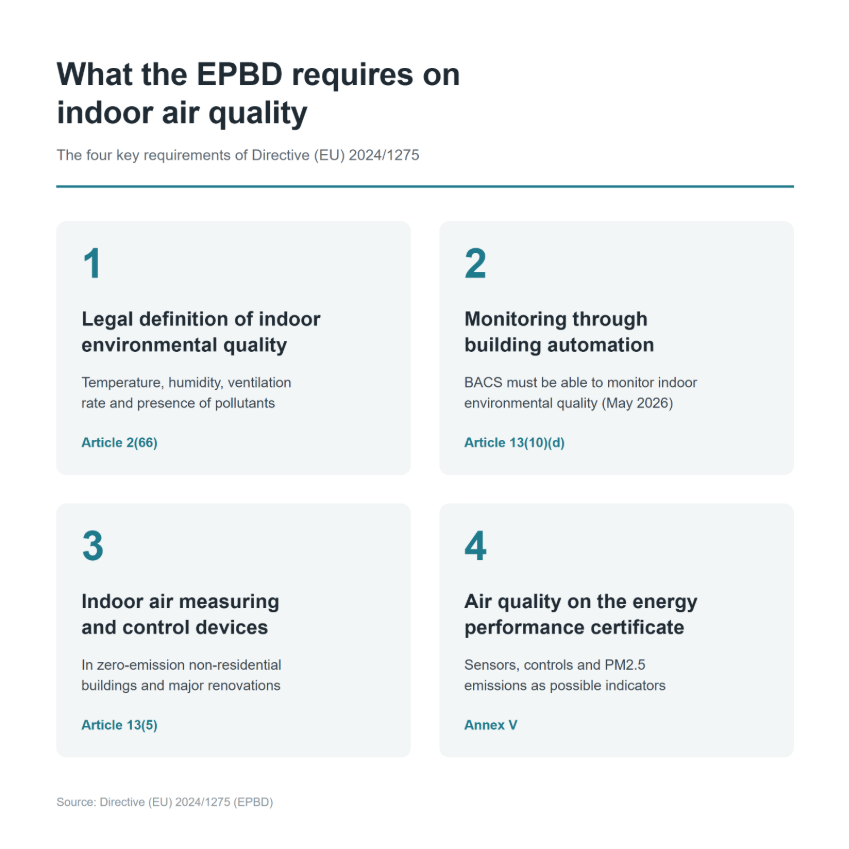
The directive sets out four key requirements:
A legal definition of indoor environmental quality. Article 2(66) defines it as the outcome of assessing the indoor conditions that affect occupants' health and wellbeing, based on temperature, humidity, ventilation rate and the pollutants present.
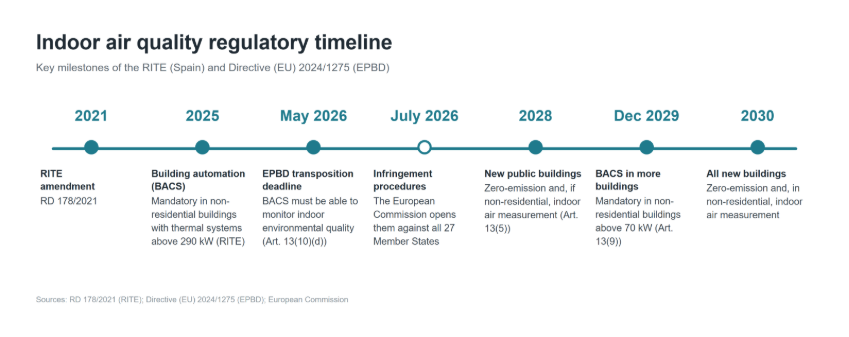
Monitoring through building automation. Since 29 May 2026, building automation and control systems (BACS) in large non-residential buildings must monitor indoor environmental quality (Article 13(10)(d)).
Indoor air quality measuring and control devices. Zero-emission non-residential buildings will have to install devices that measure and regulate indoor air quality (Article 13(5)). For new buildings, the obligation arrives with the zero-emission standard: 2028 for public buildings and 2030 for all other non-residential buildings. For existing non-residential buildings, installation becomes mandatory when a major renovation is carried out, where technically and economically feasible.
Air quality on the energy performance certificate. Energy performance certificates may include indicators on the presence of monitoring sensors, controls that respond to indoor air quality levels, or fine particulate (PM2.5) emissions generated while the building is in use (Annex V).
All four requirements depend on reliable data. Without continuous measurement, there is no way to prove that a building's air is healthy.
Indoor air quality under the EPBD starts outside the building
A healthy indoor environment starts with ventilation: bringing in outdoor air to dilute the pollutants that build up in an enclosed space.
The EPBD sets that obligation but gives no figures. Each country will set the airflow rates and acceptable CO2 levels when it transposes the directive. That said, the European Commission has published indicative values that countries can use as a reference.
bringing them closer to WHO guideline values. That outdoor air is the same air buildings use for ventilation.
In many urban areas the outdoor air is polluted. Ventilate blindly and that pollution ends up inside the building.
Ventilation has to respond to actual conditions, and that takes sensors indoors.
If CO2 rises, a sign of stale air, the fix is to bring in fresh air. If particulate levels rise, you need to know where the particles come from. If they come in from polluted outdoor air, ventilating more without filtration makes things worse, so the answer is to filter. If they are generated indoors (cooking, printers, cleaning products), ventilation or extraction helps. Measuring both indoors and outdoors is what tells you which case you are in.
The transposition process in Spain
The EPBD set 29 May 2026 as the deadline for Member States to transpose it into national law, but no country made it in time. On 15 July 2026, the European Commission opened infringement procedures against all 27 EU countries.
In Spain, a May 2026 report by Green Building Council España (GBCE) put the degree of transposition at around 60%. The main piece still missing is the update of the RITE, the Spanish regulation on thermal installations in buildings, which is expected to set minimum ventilation rates and require indoor air quality monitoring sensors. At the time of publication, the reform is still going through the approval process.
The obligations are already in the directive; the exact deadlines and values in Spain will depend on the RITE.
Three steps to meet the new requirements
Step one: know what applies to you
Not every building faces the same obligations or deadlines.
There are two questions to answer:
What type of building you manage. If your non-residential building has heating, cooling or certain combined systems with an effective rated output above 290 kW, the 2021 amendment to the RITE already required a building automation and control system (BACS) by 2025, where technically and economically feasible. The EPBD adds that these systems must be able to monitor indoor environmental quality by 29 May 2026, a capability whose details will be known once transposition is complete. From 31 December 2029, the BACS requirement extends to non-residential buildings above 70 kW.
What your automation system already measures. In some buildings, the building management system (BMS) controls heating, ventilation and air conditioning but does not integrate enough sensors to assess indoor environmental quality continuously.
Step two: decide what to measure
What to measure depends on the applicable requirements of the updated RITE, the characteristics of the building and your level of ambition.
There are three levels:
The monitoring baseline. European Commission technical guidance and industry guidelines, such as those from REHVA and Eurovent, typically cover CO2, temperature and relative humidity. CO2 is an indirect indicator of ventilation, and its reading depends on occupancy, how each space is used and the outdoor concentration. A device such as MICA Mini covers these requirements.
The industry recommendation. The same guidelines recommend adding particulate matter, especially PM2.5, when air enters unfiltered, as with natural ventilation. It can also be useful to track the volatile organic compounds (VOCs) released by paints, furniture and cleaning products. MICA and MICA Plus cover this level. The Plus version also measures formaldehyde, which a conventional total VOC sensor cannot identify.
Certification-grade monitoring. If you are aiming for a certification such as WELL, you will need solutions that also measure inorganic gases such as carbon monoxide, ozone and nitrogen dioxide. MICA WELL is designed for this level. Other certifications, such as RESET, LEED and BREEAM, also reward continuous air quality monitoring. If you already hold one, part of the work is done, because the EPBD relies on the same logic of continuous monitoring and data-based verification.
Step three: turn measurement into evidence and a decision tool
Measuring is not enough if the data stays on the device. Two more things are needed:
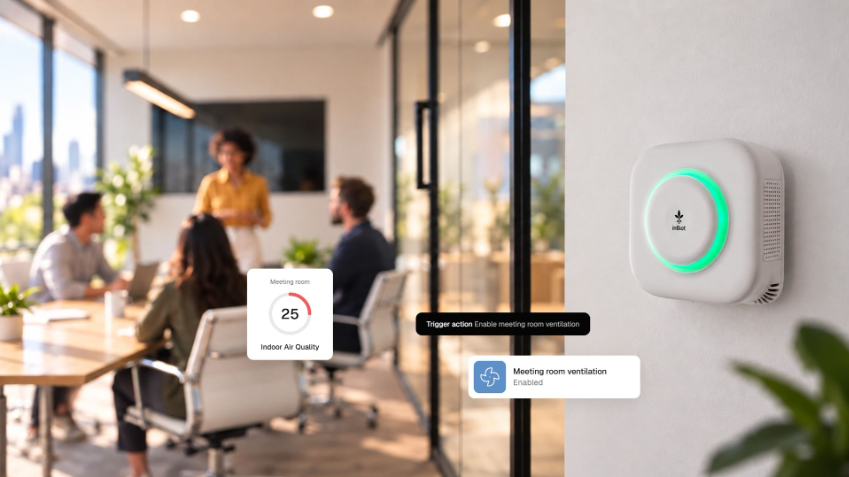
the data has to trigger action. MICA devices integrate natively with the control system via Modbus and BACnet, so ventilation can respond to what the sensors show; and
the data has to be recorded. The My inBiot platform keeps the full, exportable history. That record makes it easier to verify how the system performs and, as long as the data is traceable, provides documentary evidence for audits and inspections.
Indoor air quality is no longer optional
The EPBD puts indoor air quality monitoring on a par with energy efficiency. Transposition in Spain is moving slowly, but the direction is clear and the deadlines are already known.
Adapting does not require major works. With the right sensors, integration with building systems and a data record, measuring indoor air quality under the EPBD becomes one more part of day-to-day building management.
Want to know what the EPBD requires of your building and what you need to measure? Tell us about your project and we will help you define your monitoring: Talk to a specialist.
Further reading
European Commission: guidance on the recast EPBD, section 10, on technical building systems, indoor environmental quality and inspections.