Products


Achieving WELL certification doesn't close the project, it opens it. The standard requires recertification every three years, turning compliance into an ongoing process rather than a one-off milestone. For Facility Management teams running the building day to day, this translates into a concrete task: demonstrating at all times that indoor air quality stays within required thresholds, without that meaning an audit review every time someone asks.
The traditional verification model, point-in-time measurements taken by a third party, captures a snapshot of the building at a single moment. It's sufficient for initial certification, but it provides no traceability between audits. If a parameter drifts six months after the measurement, the maintenance team won't detect it until the next review, by which point it's too late to correct without impact.
WELL, through its Feature A08, already recognizes continuous monitoring as a compliance pathway. For the Facility Manager, this changes the nature of the problem: instead of preparing for an exam every three years, the task becomes sustaining reliable, visible data at all times, data that both justifies compliance and flags issues before they turn into complaints.
A device that measures with precision doesn't solve anything if the data stays on the device itself. To be useful day to day, it has to reach a panel where the maintenance team can see it, compare it and act: trigger an alert, generate a ticket, adjust ventilation based on occupancy.
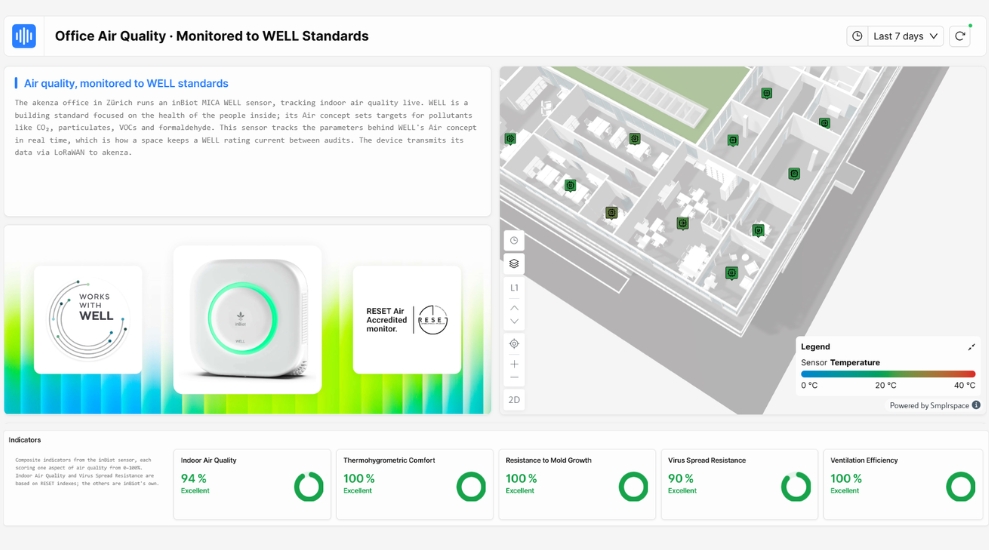
The MICA's versatility makes exactly this possible. Its range of connectivity options (Wi-Fi, LoRaWAN, NB-IoT/LTE-M, Sigfox) allows it to adapt to infrastructure already installed in the building, without additional works, and its data leaves the device structured and ready to integrate into IoT management platforms such as Akenza. That's where the operational value takes shape: real-time dashboards, configurable without custom development, with historical data available for any audit and visible to whoever needs to consult it, from the maintenance team to the occupant.
This is where integration with partners like Akenza adds value: the device's data is displayed alongside the rest of the building's information. A practical example of what this looks like is the public dashboard with real-time data from a MICA WELL integrated with Akenza.
Calibration is one of the points where operations suffer most. A device that has to be removed from the building for calibration not only creates a gap in the historical record (something WELL and RESET penalize), it also means coordinating a site visit, dismantling the unit and reinstalling it. For a Facility Manager managing several buildings or vendors, each visit costs time and coordination.
inBiot's replacement model, with the device swapped out every three years in line with the WELL recertification cycle, avoids all of that: the unit is replaced without interrupting the data series or requiring on-site calibration, which reduces the maintenance operational load while sustaining the traceability the certification requires.
WELL certification no longer depends on a single measurement; it now rests on continuous data infrastructure, visible on a dashboard and auditable at any time. For the Facility Manager, this means fewer surprises at recertification and greater capacity to act before an out-of-range reading turns into a complaint or a maintenance incident.
This principle will be put into practice on October 7th at IoT Sparks 2026 in Valencia, where inBiot and Akenza will monitor the event's air quality in real time at the Palau de les Arts, with data publicly visible throughout the day: the same logic that sustains WELL compliance in a building, applied at the scale of an event.