Products


On 29 June 2026, smoke from fires roughly 800 km to the northeast settled over the Bow Valley in Alberta. Canada’s Air Quality Health Index reached 11, above the top of its normal 1 to 10 scale, and the public guidance was the usual one: stay indoors.
Inside a long term care facility in Canmore, an inBiot MICA had been recording indoor air quality every 15 minutes throughout. So we could check something the guidance never tells you: how much protection staying indoors actually provided.
Outdoor PM2.5 peaked at 87 µg/m³ while indoor concentrations averaged 33.4% of outdoor across the six days, better than the 55 to 60% that ASHRAE’s wildfire smoke guideline treats as typical for a building with its openings closed.
We then read the same six days against three international references, each built for a different purpose:
Each answers a different question, over a different averaging period. Reading them together is what gives a building the full picture.
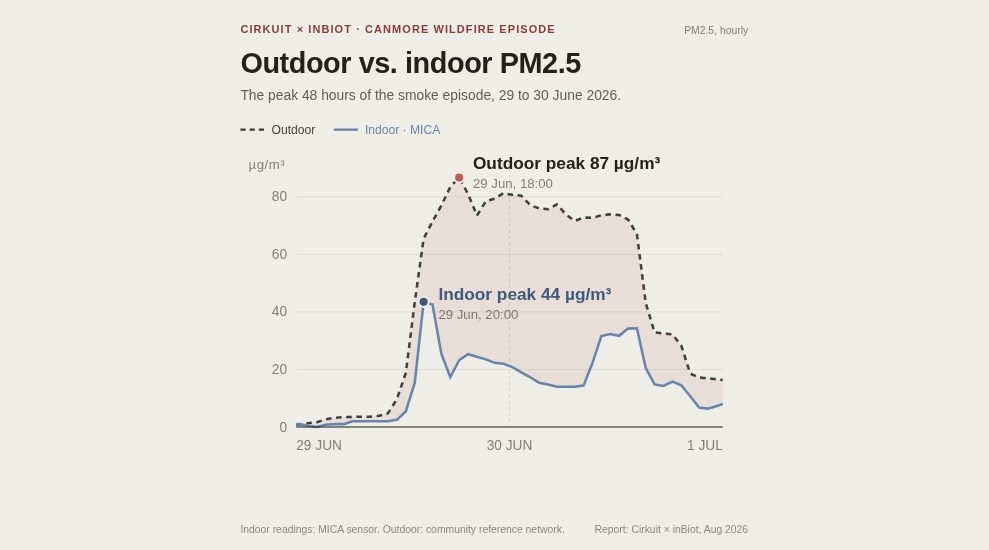
The full analysis sets out what each standard measures and why the averaging period changes the answer, what the nearest official reference stations 100 km away missed about local conditions, and what CO₂ was doing throughout. A monitor measuring only CO₂ would have registered nothing during the entire event.
This analysis is retrospective. Anne, inBiot’s AI IAQ consultant, applies the same benchmarks, WELL v2, EU EPBD, GO IAQS, ASHRAE and WHO, continuously wherever a MICA is running.
Produced with Cirkuit, the Calgary based smart building platform whose client made this data available.