Productos


Choosing a quality indoor air monitor is, in practice, a matter of trust. There are hundreds of devices on the market based on low-cost sensors, and very few have undergone independent evaluation that allows them to be compared with one another under the same conditions. Technical specifications mention ranges and resolutions, but they rarely answer the question that matters most to building managers: will this data hold up when faced with an auditor, a ventilation system, or an occupant who asks why an alert has been triggered?
The AIRLAB Microsensors Challenge was created precisely to address this issue. It is organized by Airparif, the accredited air quality monitoring association for the Île-de-France region, and in its fifth edition, it evaluated 47 device models from Europe, North America, Asia, and Africa. MICA, the indoor air quality monitor we design and manufacture in Mutilva, took first place in overall performance in all three indoor air categories in which it competed, and second place in the subway station category. Before delving into the figures, it’s worth explaining how they’re arrived at, because that’s what gives the results their value.
This is the first distinction you need to understand in order to interpret the ranking correctly.
A test environment is a physical location with specific conditions where Airparif installs the devices alongside reference analyzers. This edition expanded the test environments compared to previous calls for proposals, specifically to study how factors such as weather, high pollution levels, and confined spaces affect the performance of the microsensors.
For outdoor air, the tests were conducted in three cities with very different climatic conditions and pollution levels: Accra (Ghana), Paris (France), and Bengaluru (India). In each city, the two outdoor use categories, awareness and monitoring, were evaluated, meaning that the same model may yield different results depending on the city where it was tested.
For indoor air, the tests were conducted exclusively in Paris. Non-specific indoor air was evaluated at the Airparif metrology laboratory, a room equipped for full-scale exposure testing. And, as a new feature of this edition, an underground train station environment was added, evaluated on the platform at the Avenue Foch station on the RER C line, in collaboration with SNCF Gares & Connexions and Île-de-France Mobilités.
A usage category is something different: it refers to the purpose for which the device will be used. Within the same environment, Airparif rates each device multiple times, once for each intended use, because the requirements vary depending on how the data will be used. A device designed to inform occupants does not have the same requirements as one that automatically regulates ventilation. For indoor air, there are three categories: awareness (IA-A), monitoring (IA-M), and piloting (IA-P).
To put it in terms relevant here: the results are published by environment, and within each environment, by usage category. A device may perform differently in two environments; it may be excellent for one purpose and only adequate for another.
Each device receives a final rating out of 5 stars, which is the weighted average of five criteria: accuracy, utility, usability, environmental footprint, and cost. The weighting of each criterion varies depending on the usage category, which is why the same device may receive different ratings for awareness, monitoring, and piloting.
Accuracy is not simply a matter of a single average error. Airparif calculates it using an integrated index derived from the SET method, which aggregates nine metrics: normalized root mean square error; Pearson, Kendall, and Spearman correlations; presence of valid data; ability to classify air quality levels; low-frequency energy; trueness based on the slope and intercept of the regression relative to the reference; and reproducibility. This last metric deserves special mention: for each candidate model, three units are evaluated per environment, so that the test measures not only how close the device is to the reference but also how similar three units from the same production batch are to one another. The combined variability is calculated according to the CEN/TS 17660 technical specification, whose application to indoor air and particulate matter constitutes a methodological extension unique to AIRLAB.
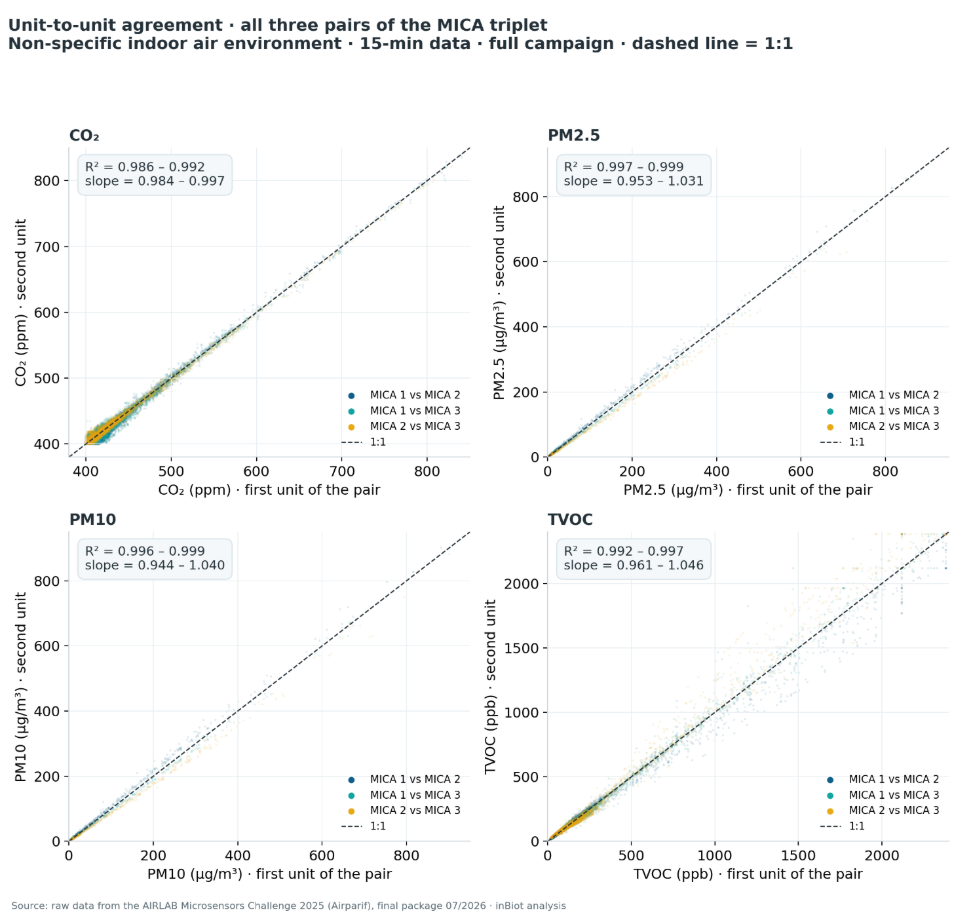
Regulatory-grade analyzers were used as a reference: a PALAS Fidas 200 optical spectrometer for PM10, PM2.5, and PM1; a Thermo Scientific 410i NDIR analyzer for CO2; a Syntech Spectras GC 955 gas chromatograph for volatile organic compounds; and DNPH cartridges with HPLC analysis for formaldehyde. At the Avenue Foch platform, the particulate matter reference was a Thermo Scientific TEOM 1405-F analyzer. The protocol requires a minimum of ten days of valid data per environment; the 2025 campaign lasted approximately four months, from October 2025 to February 2026, with controlled scenarios involving cooking, candles, incense, cleaning products, and conventional and electronic tobacco, to expose the sensors to the sources of pollution that actually occur in an occupied space.
The other four criteria evaluate aspects that do not depend on the sensor alone but on the entire chain of device, connectivity, and platform. Utility measures whether the data is useful for operations: interoperability, data retrieval, real-time alerts, availability of historical data, and statistics. Usability encompasses ease of use, battery life, weight, and installation. The environmental footprint assesses material efficiency, distance between manufacturing and deployment, the share of renewable energy in production, maintenance frequency, expected service life, and end-of-life management. And cost is weighted differently depending on the usage category.
The MICA monitor was evaluated in two environments, both at the Paris headquarters: the non-specific indoor air environment and the platform at the Avenue Foch station on the RER C line. It was not tested at the sites in Ghana or India.
In the non-specific indoor air environment, the device ranked first in overall performance across the three usage categories evaluated: 4.35 out of 5 for awareness, 4.30 for monitoring, and 4.60 for piloting, the latter being the highest score for any indoor air device in this edition. Twelve devices submitted by nine manufacturers from France, Spain, Switzerland, Poland, Romania, and Thailand were evaluated in this category.
In the underground train station environment, a category included for the first time and featuring particle levels far higher than those in an office building, MICA achieved the second-best result in overall performance, with a score of 4.25 out of 5.
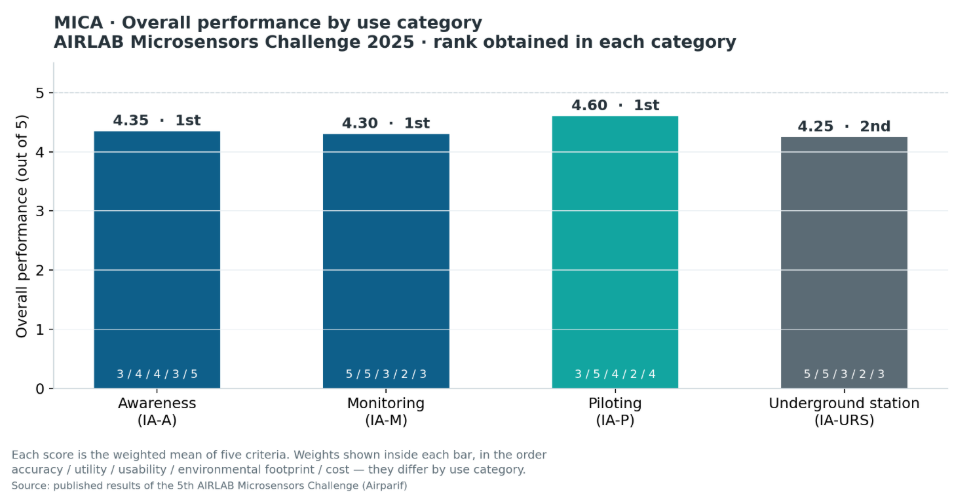
Behind the overall score is a breakdown by criterion that better explains where the result comes from. In the non-specific indoor air category, the MICA monitor ranked first in the following criteria:
In absolute terms, on the 0-to-10 scale used by the report, the device achieved the maximum score of 10 out of 10 for utility across all three indoor air quality categories, and 9.33 out of 10 for environmental footprint, with a perfect 10 out of 10 for lifespan and durability.
The utility criterion is probably the most revealing for building managers, because it is the one that breaks down when a project fails. A sensor may take accurate measurements and still be useless if the data cannot be retrieved, does not integrate with the building management system, does not generate alerts when needed, or does not retain the historical data that a certification process will require months later. This criterion does not evaluate the sensor alone; it evaluates the entire chain: device, connectivity, and platform. In our case, the My inBiot platform is an integral part of that outcome.
The environmental footprint criterion works similarly: it does not evaluate statements of intent, but rather design and production decisions with measurable effects. Designing and manufacturing in Mutilva shortens the distance between production and deployment in our main markets. The service life reaches ten years in configurations that do not incorporate electrochemical sensors, which reduces both maintenance and the generation of electronic waste. And the casings are fully recyclable and free of single-use plastics.
This approach is not haphazard. We develop our product line under management systems certified for quality (ISO 9001) and eco-design (ISO 14006), the latter specifically because it integrates environmental criteria into the product design phase rather than at the end of the process. It is also the framework that ensures consistency across units, as measured by the Challenge’s reproducibility test: three units from the same series must perform consistently, and this consistency is established during production, not in the testing laboratory.
At the corporate level, inBiot holds the Reconcilia seal and the “Healthy Company” designation, has an equality policy in place, and is a signatory to the United Nations Global Compact. These frameworks do not count toward the Challenge’s scoring, but they follow the same logic: the conditions under which a device is manufactured are part of what that device is.
An independent result is of little use if only the favorable part is reported. The Airparif report highlights MICA’s excellent performance regarding PM2.5 and PM10 in the two indoor environments evaluated and regarding CO2 in non-specific spaces, while also noting that volatile organic compounds remain the most difficult parameter to measure using microsensor technology. This is a limitation common to the entire industry, not unique to any single manufacturer, and it should be kept in mind when determining which decisions are made based on which parameters within a building. It is also important to clarify what constitutes good performance regarding particulate matter: the Challenge data show that MICA accurately reproduces the temporal dynamics, Pearson correlations ranging from 0.85 to 0.94 compared to the reference, while the regression slope ranges from 0.40 in the laboratory to 0.19 on the subway platform. In the terms of ISO 5725: high precision and correlation, with more limited trueness in environments with very high concentrations and particles of metallic origin.
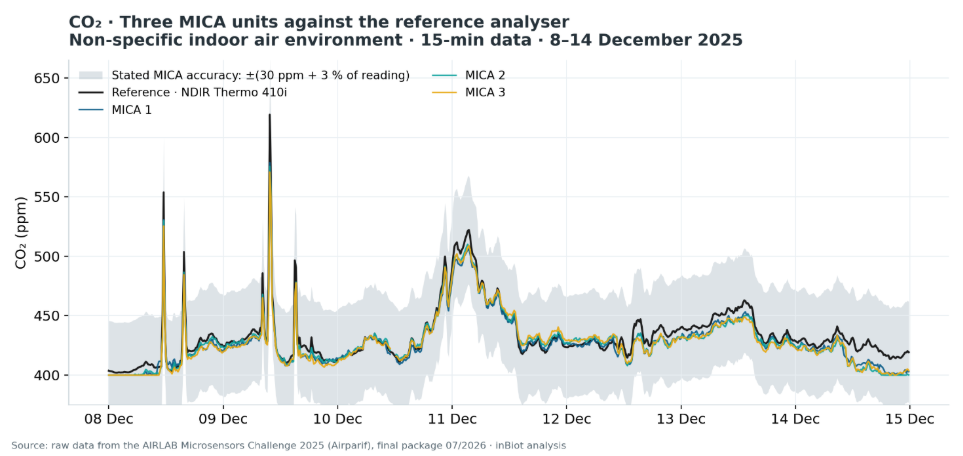
That transparency is, at its core, the value of the exercise. Airparif evaluates all candidate devices simultaneously and using the same protocol, so that each edition serves as a snapshot of the market’s actual state, with its strengths and limitations. This fifth edition builds on the experience of the 2018, 2019, 2021, and 2023 editions. It is worth noting a clarification set forth by the protocol itself: the results are published for informational purposes only and do not constitute a guarantee of product performance. The Challenge is an independent comparative evaluation, not a certification program.
The results of the 5th edition of the AIRLAB Microsensors Challenge are publicly available and can be viewed device by device and criterion by criterion. We recommend reviewing them directly, both to verify the information summarized here and to compare options based on your own criteria.
Interactive results platform: https://airparif.shinyapps.io/2025-AIRLAB_Challenge_Results/
AIRLAB results publication: https://airlab.solutions/en/actualites/resultats-du-challenge-airlab-microcapteurs-2025-231
Airparif report on microsensors: https://www.airparif.fr/dossiers-fiches-thematiques/2023/airparif-dossier-9-les-microcapteurs